
Root Beer–Braised Brisket for Fork-Tender Slices and Deep, Spiced Flavor
Why root beer works in a brisket braise
Braising brisket in soda is a familiar technique, but using root beer leans into a distinct spiced profile that can make the finished dish feel especially aromatic. In this approach, the braising liquid doesn’t rely on root beer alone. Instead, it is supported by warm spices—star anise, ginger, and cinnamon—so the drink’s character is echoed and amplified rather than masked. The result is a brisket that is deeply flavorful and notably tender, with onions that soften into the sauce as the meat cooks low and slow.
Balance is also built into the braise. Worcestershire sauce boosts savory, umami notes and helps counter the sweetness contributed by the root beer and brown sugar. Tomato paste adds body, while vinegar is included to keep the flavor from tipping too far into sweet. After several hours in the oven, the brisket becomes juicy enough that, once sliced, it can be eaten without needing a knife.
The make-ahead method that improves texture and flavor
This brisket is designed with make-ahead cooking in mind, and the timing is not just for convenience. After the brisket finishes braising and has cooled, it is refrigerated—at least four hours, and preferably overnight. This chilling step is essential because it makes excess fat easy to remove: the fat rises and solidifies on the surface, so it can be spooned off cleanly before reheating. Just as importantly, resting the brisket in its sauce allows the flavors to deepen and develop.
When it’s time to serve, the brisket is sliced against the grain and warmed directly in the simmering sauce. A brief covered reheat in the oven brings everything back to serving temperature while keeping the meat moist.
Key ingredients and what they contribute
- Brisket: Braised until fork-tender, then sliced against the grain into thin pieces.
- Root beer: Forms the base of the braising liquid and brings a spiced sweetness.
- Star anise, ginger, cinnamon: Reinforce the warm spice notes associated with root beer.
- Worcestershire sauce: Adds savory depth and balances sweetness.
- Yellow onions: Cook down until tender and browned at the edges, then melt into the sauce during the braise.
- Tomato paste: Adds richness and helps round out the sauce.
- Brown sugar and vinegar: Sweetness and acidity working together for balance.
- Broth and flour: Broth deglazes browned bits; flour coats onions briefly to help give the sauce body.
- Kosher salt, pepper, paprika: Season the brisket before searing and braising.
Step-by-step overview of the cooking process
The process begins by preparing the brisket for seasoning and browning. The meat is patted dry, then pricked all over with a fork. It is seasoned with pepper, paprika, and most of the kosher salt, and then left at room temperature for 30 minutes. (If you want to plan ahead, the seasoned brisket can be covered and refrigerated for up to 12 hours.)
Next comes the sear. With the oven preheated to 300°F, neutral oil is heated in a large stovetop-safe roasting pan over medium-high heat. The brisket is browned on both sides—about 6 to 7 minutes per side—then moved to a rimmed baking sheet while the aromatics and sauce base are built in the same pan.
Sliced yellow onions are cooked until softened and browned on the edges, which takes about 8 to 10 minutes. Flour is stirred in briefly—just long enough to coat the onions—before broth is added to scrape up any browned bits from the bottom of the pan. Root beer, tomato paste, Worcestershire sauce, brown sugar, vinegar, star anise (optional), cinnamon, ginger, and the remaining salt are stirred in and brought to a simmer.
Once the sauce is simmering, the brisket is returned to the pan and spooned with some of the liquid. A sheet of parchment paper is laid over the brisket, and the pan is sealed tightly with aluminum foil. The brisket braises in the oven until fork-tender, about 3 1/2 to 4 hours.
After cooking, the brisket cools in the roasting pan until it reaches room temperature (about 1 hour). Then it is refrigerated, covered, until chilled—at least 4 hours, and preferably overnight (around 12 hours). This is the stage that makes fat removal easy and allows the flavors to settle.
Finishing, slicing, and reheating for serving
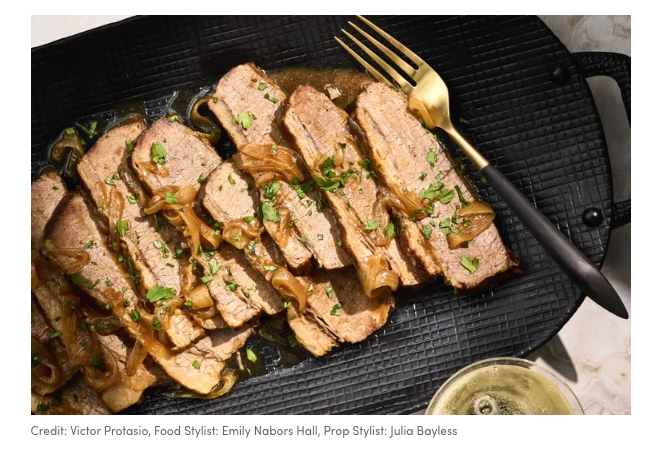
To serve, the oven is again set to 300°F. Any solidified fat is spooned off and discarded. The brisket is transferred to a cutting board and sliced against the grain into 1/4-inch-thick slices. Meanwhile, the sauce is brought to a simmer on the stovetop. The sliced brisket is nestled back into the sauce, covered, and heated in the oven until warmed through—about 20 minutes.
For presentation, the brisket can be transferred to a serving platter and garnished with parsley. Because the slices are reheated in the sauce, they stay juicy and tender, and the onions and braising liquid serve as a built-in accompaniment.
Make-ahead and storage notes
- The brisket can be seasoned up to 2 days before serving.
- It can be cooked 1 day before serving and reheated when ready to serve.
- Leftovers can be stored in an airtight container in the refrigerator for up to 4 days.
This method is particularly useful for gatherings or any meal where you want the main dish ready to reheat and serve. The overnight chill not only streamlines finishing, but also helps deliver the deeply flavored, fall-apart tenderness that defines this root beer–braised brisket.